

Spectrum Model of Workplace Interactions
How everyday interactions shape people’s ability to contribute and teams’ ability to perform
Introducing our Model
Workplace culture is shaped everyday. It is shaped by thousands of moments that happen everyday. How people speak to one another, how concerns are responded to, whose voices are heard, what gets laughed off, and what becomes normal over time.
Some behaviours are easy to spot. Others are far more subtle.
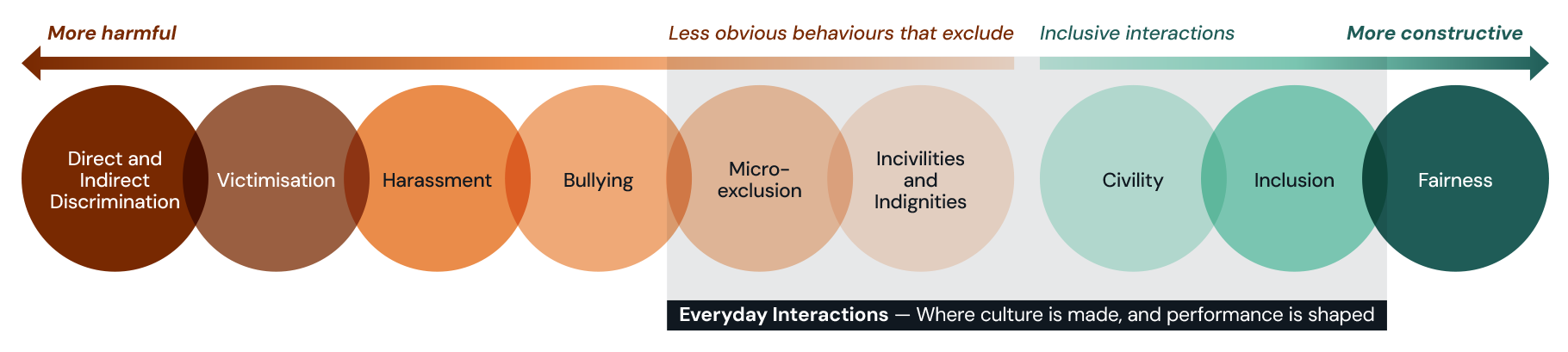
The Spectrum Model of Workplace Interactions presents a way of understanding workplace interactions that support inclusion, trust and collaboration – and those that work against healthy, high-performing workplace relationships.

The Spectrum Model of Workplace Interactions © Zoe Young / Half the Sky
Why the middle ground matters
Everything in the orange and red zones creates harm. But many of the behaviours that have the greatest impact on workplace culture sit in the middle ground: repeated everyday interactions that are often minimised, rationalised or left unresolved.
This middle ground can include incivilities and indignities such as:
rudeness, snubs, sneers, condescending gestures, talking down to people, insults disguised as humour, repeated interruptions, dismissive responses, or shouting under pressure.
The middle ground also includes microaggressions: subtle language or behaviour that feels hostile, diminishing or excluding in relation to some aspect of identity such as race, sex, age, disability, sexuality, religion or gender identity.
Individually, these moments may appear small.
But repeated over time, they accumulate. And in busy, high-pressured environments it is all too easy for these behaviours to become normalised:
“That’s just how they are.”
“Everyone’s under pressure.”
“They didn’t mean anything by it.”
When everyday behaviours are continuously tolerated, or left unresolved, tensions can quickly escalate. People learn quickly whether speaking up is safe, whether managers follow through, and whether repair is possible.
Across Half the Sky’s work in legal, justice, care, hospitality and public service environments, one pattern appears repeatedly:
Most workplace problems do not begin with overt misconduct. They emerge through repeated everyday behaviours that are tolerated, minimised or left unresolved.
Culture forms in these moments.
Putting it into practice – Spotting the “Middle Ground”
This simple conversation and reflection tool can help leaders and teams identify early signs that workplace relationships or team culture may be beginning to drift.
You can use it as a tool for self-reflection, or discussion with colleagues or your team.
The Spectrum Model of Workplace Interactions © Zoe Young / Half the Sky
Step 1: Look for what is changing
Consider each of the six areas below. What are you noticing in your team or organisation?
Communication
Ask yourself: Is tone becoming shorter or more abrupt? Are you noticing avoidance, dismissive responses or people talking over one another?
Participation
Ask yourself: Are some voices withdrawing or being overlooked? Who contributes freely – and who doesn’t?
Challenge
Ask yourself: Are concerns raised less directly or not at all? Do people feel safe to disagree?
Relationships
Ask yourself: Is humour becoming sharper or exclusionary? Are tensions emerging between people or groups?
Response
Ask yourself: Are issues acknowledged but not followed through? Do people trust that something will happen if they raise a concern?
Team norms
Ask yourself: Are people adapting around difficult behaviour rather than addressing it?
Step 2. Ask Five Questions
Use these questions to help you understand what’s happening in your organisation.
What behaviours are becoming normalised under pressure?
Where are people staying quiet rather than speaking openly?
What tensions are being worked around rather than addressed?
What gets laughed off or minimised?
What do new starters quickly learn about “how things work here”?
Most workplace cultures do not deteriorate through dramatic incidents alone. More often, they drift through repeated everyday interactions that nobody quite addresses.
Step 3. Identify what needs to change
Think about the behaviour or pattern that would make the greatest difference to the team.
Ask yourself:
What impact is it having on people or performance?
What would we like to see happening instead?
What is one practical step we can take now?
How will we know whether things have improved?